For most business owners in the Philippines, the very first question that comes up when planning a digital shift is simple: “Magkano ba talaga ang website?”
If you ask around, the answers you get will likely frustrate you. One freelancer might quote you ₱10,000, while a Makati-based agency might hand you a proposal for ₱300,000 for what looks like the exact same thing. After 15 years in the web design industry, I have seen every type of proposal, pricing model, and client reaction. The massive gap in web design pricing Manila and the provinces is usually where business owners get stuck, leading them to either overpay for something they don’t need or underinvest in something that ultimately hurts their brand.
I wrote this guide to pull back the curtain on the true website development cost Philippines. My goal is to give you a realistic breakdown of what a website actually costs in 2026, where your money goes, and how to avoid the expensive mistakes I see happen entirely too often.
The Real Price Tags: 2026 Website Cost Tiers
Let’s look at the numbers. Based on current market rates and my own experience pricing out projects, website costs generally fall into three distinct tiers. Keep in mind that these are estimates, and the final price always depends on your specific requirements.
Tier 1: The Basic Brochure Website (₱15,000 – ₱60,000)
This is the digital equivalent of handing out a well-designed business card. A basic brochure website usually consists of 5 to 10 pages, including your Home, About Us, Services, and Contact pages. This is typically the starting point for a standard small business website Philippines.
At the lower end of this range, you are typically working with a junior freelancer who will use a pre-built template or a drag-and-drop builder to get you online quickly. At the higher end, an experienced freelancer or a small agency will take the time to customize that theme to match your branding, optimize the images so the site loads fast, and set up basic on-page structure.
Who this is for: Startups validating an idea, local mom-and-pop shops, or traditional service businesses that just need a professional online presence so customers can find their contact details.
Tier 2: The Semi-Custom Corporate Website (₱60,000 – ₱150,000)
When a business outgrows its Facebook page and needs a serious brand positioning tool, this is the tier they look at. Corporate websites are larger—often 20 to 50 pages—and they require better architecture.
At this price point, developers spend significantly more time on user experience (UX), conversion rate optimization (CRO), and integrating local SEO strategies. You will get custom post types for your news or blog sections, better performance optimization, lead generation forms, and perhaps integration with your CRM or email marketing software.
Tier 3: Fully Custom and E-Commerce Platforms (₱180,000 – ₱500,000+)
This is where development gets serious. If you are wondering how to build an online store Philippines that handles thousands of products, automated inventory syncing, custom user dashboards, or highly specific booking engines, you are looking at a fully custom build.
When calculating your total ecommerce website cost Philippines, you are paying for a team: a dedicated project manager, a UI/UX designer, front-end and back-end developers, and a quality assurance tester. The focus here is on enterprise-grade security, lightning-fast performance, and scalable architecture that can handle heavy traffic without crashing.
DIY vs. Freelancer vs. Web Agency: What’s the Best Route?
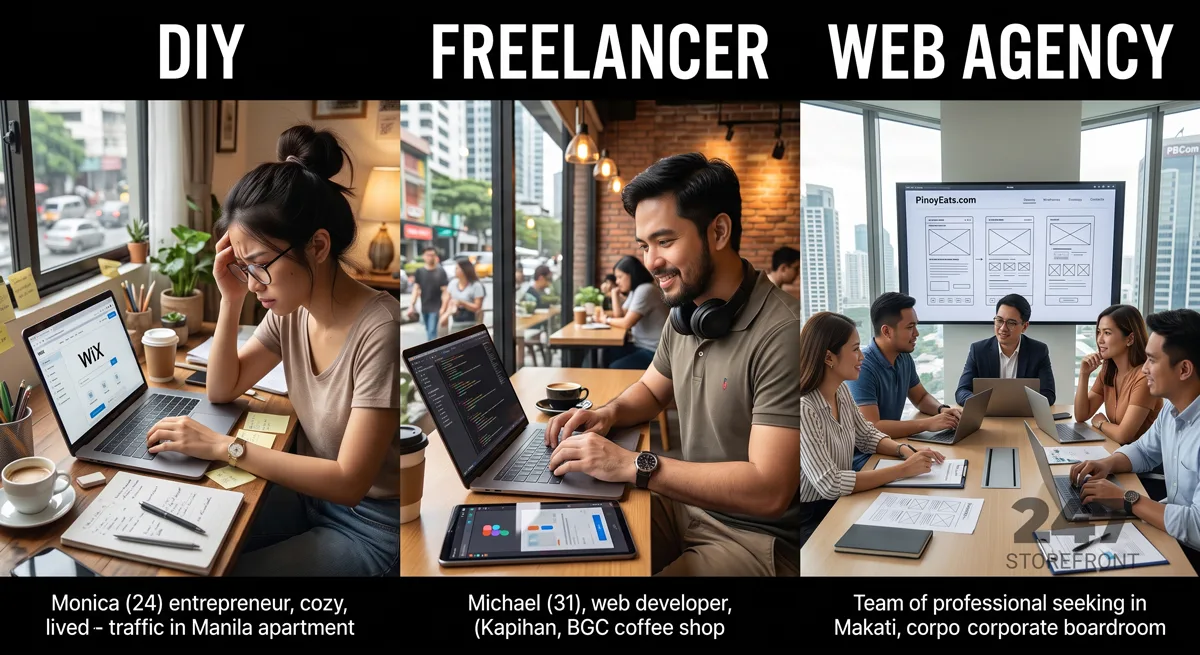
One of the biggest decisions you have to make when you want to hire web developer Philippines is who will actually build the site. Over the years, I’ve seen businesses succeed and fail with all three options. To understand all the differences between freelancers and agencies, here is a realistic comparison of what to expect:
| Approach | Typical Cost | Timeline | Best For |
|---|---|---|---|
| DIY (Wix, Shopify, Canva) | ₱1,000 – ₱3,000/mo | 1 – 4 Weeks | Bootstrapped solo founders with time to spare. |
| Freelancer | ₱15,000 – ₱80,000 | 3 – 6 Weeks | Small businesses with a limited budget exploring standard freelance web designer rates PH. |
| Web Agency | ₱80,000 – ₱500,000+ | 8 – 16 Weeks | SMEs and Corporations needing a hands-off, professional experience. |
From what I’ve seen, the sweet spot for a growing Filipino business is usually a senior freelancer or a boutique web agency. They offer the perfect balance of professional quality without the bloated overhead costs of massive corporate agencies.
The Ongoing Website Costs You Can’t Ignore
A website is not a one-time purchase. Think of it like a physical storefront—you have to pay rent, keep the lights on, and handle routine maintenance. If a developer tells you there are zero ongoing costs, they are either lying or setting you up for failure.
Domain Names
Your domain name is your address on the internet (e.g., yourbusiness.com). Standard .com domains are relatively cheap, usually costing around ₱500 to ₱800 per year. However, if you want a localized .ph or .com.ph domain to build immediate trust with Filipino consumers, it is more expensive. Checking the official dotPH Registry, the standard dotPH domain price currently sits at $48 USD per year, which translates to roughly ₱2,700 to ₱2,900 annually.
Web Hosting
Hosting is the server space where your website’s files live. You can find cheap shared hosting for around ₱300 a month, but your site will likely load slowly during peak hours. For a growing business, a solid professional hosting plan will cost anywhere from $15 to $35 a month (roughly ₱850 to ₱2,000). If you run a high-traffic e-commerce store, expect to pay significantly more for dedicated or cloud hosting.
Maintenance and Security
Websites need to be updated. If you use WordPress (the standard open-source platform), the core software, themes, and plugins require regular updates to prevent security vulnerabilities. When calculating your total WordPress website cost Philippines, I highly recommend setting aside ₱2,000 to ₱5,000 a month to have a professional handle your backups, security scans, and software updates. Trying to save money by skipping maintenance is the fastest way to get your website hacked.
The Hidden Costs of E-Commerce in the Philippines
If you plan to sell online, choosing the right e-commerce platform is only half the battle. You need to accept the payment methods Filipinos actually use. Relying solely on PayPal or bank deposits will kill your conversion rates.
Integrating local payment gateways gives you access to GCash, Maya, and credit cards. While there is usually no setup fee to create an account, you must account for PayMongo transaction fees (or similar gateway fees) which will eat into your margins. If you aren’t sure how to set up PayMongo, your developer will need to handle the API integration.
According to PayMongo’s official pricing documentation, transaction rates for 2026 look like this:
- GCash: 2.23% per transaction.
- Maya: 1.79% per transaction.
- Credit/Debit Cards (Visa/Mastercard): 3.125% plus a fixed fee of ₱13.39 per transaction.
Beyond payments, setting up automated shipping calculators for local couriers like LBC, J&T Express, or GrabExpress usually requires premium plugins or custom API development from platforms like WooCommerce, which adds to your initial development cost.
Common Mistakes When Choosing the Cheapest Option
Business owners are naturally wired to look for the best deal. But going with the absolute lowest bidder for web design almost always ends up costing more in the long run. Here are the most common traps I help clients dig themselves out of:
- Holding the Domain Hostage: Shady developers will register your domain name under their own personal email address instead of yours. When you try to leave them, they demand a massive ransom to hand over the rights to your own brand name. Always insist that you purchase the domain yourself.
- Terrible Mobile Experience: Over 70% of web traffic in the Philippines comes from mobile phones. Given the importance of mobile optimization confirmed by Google’s mobile-first indexing guidelines, a site that is completely broken on a smartphone is useless to your business.
- The “Ghosting” Developer: You pay a 50% downpayment to a freelancer you found on Facebook. They build half the site, get overwhelmed, and completely stop answering your messages. Always work with professionals who have verifiable local references and a clear contract.
How to Determine the Right Budget for Your Business

So, how much should you actually spend?
Stop looking at web design as an expense and start looking at it as a sales employee that works 24/7 without taking a holiday. To determine your budget, calculate the lifetime value of a single customer.
If you run a B2B consulting firm and one new client brings in ₱50,000 in revenue, a ₱100,000 website pays for itself after just two conversions. If you run a local bakery selling ₱300 pastries, you need a high volume of sales to justify a massive custom build, so starting with a ₱30,000 semi-custom site makes much more financial sense.
Map out your goals for the next two years. If you plan to scale aggressively, invest in a scalable foundation now. If you just need a digital calling card while you validate your business model, keep it lean and upgrade later. Find a partner you trust, set a realistic budget based on the data above, and build a digital presence that actually moves the needle for your business.
Frequently Asked Questions
How much is the cheapest website for a small business?
A basic template-based website built by a freelancer usually starts around ₱15,000. However, this will be very limited in functionality and is best suited only for businesses that just need a simple digital calling card.
Do I have to pay monthly fees for my website?
Yes. While the design is a one-time cost, you must pay for web hosting (server space) and domain name renewals. A professional hosting setup usually costs between ₱800 and ₱2,000 per month.
Are .ph domains more expensive than .com domains?
Yes. A standard .com domain costs roughly ₱500 to ₱800 per year, while a .ph or .com.ph domain registered through dotPH costs $48 USD (approximately ₱2,800) per year.
How much does an e-commerce website cost in the Philippines?
A robust e-commerce website that handles inventory, automated shipping, and local payment gateways (like GCash and Maya) typically starts at around ₱100,000 and can easily exceed ₱300,000 depending on complexity.
Does PayMongo charge a setup fee for websites?
No, setting up a PayMongo account is free. They make money by charging a transaction fee on every successful payment (e.g., 2.23% for GCash and 3.125% + ₱13.39 for credit cards).