If you run a business in the Philippines, there is a 90% chance you started on Facebook. It makes total sense. Setting up a Facebook Page takes less than five minutes, costs zero pesos, and instantly connects you to over 80 million active Filipino social media users.
For a long time, a social media page was enough. You posted photos, ran a few boosted ads, answered inquiries through Messenger, and collected payments via bank transfer or GCash. But if you have noticed your organic reach dropping over the past year or felt the exhausting fatigue of answering “How much?” fifty times a day, you are not alone.
Relying exclusively on social media is one of the biggest bottlenecks for growing Filipino companies. Here is a real-world breakdown of why depending solely on a facebook page for business philippines is silently costing you revenue—and how having an official website fixes it.
1. You Don’t Own Your Facebook Page (Meta Does)
The single biggest risk of building your entire business on social media is simple: you are building on rented land. Meta owns your page, your follower list, and your content. You are entirely at the mercy of their algorithm updates and policies.
Over the years, I have seen thriving local brands lose their entire monthly revenue overnight because of three common scenarios:
- System Outages: When Facebook, Instagram, or WhatsApp experience global downtime, your storefront is effectively closed. You cannot process orders, respond to leads, or run ads.
- Algorithm Penalties: Facebook constantly shifts its algorithm to prioritize paid ads or short-form video. Your organic reach—the percentage of followers who actually see your posts without paid boosting—has dropped to as low as 1% to 2%.
- Accidental Account Bans: Automated moderation bots frequently flag and disable legitimate business accounts by mistake. Recovering a locked Meta Business Suite account in the Philippines can take weeks, or sometimes months, with no human support to talk to.
When you own a domain name and a self-hosted website, no algorithm can turn off your business. Your content, client data, and storefront remain 100% under your control.
2. The “PM Sent” Fatigue Kills High-Intent Buyers
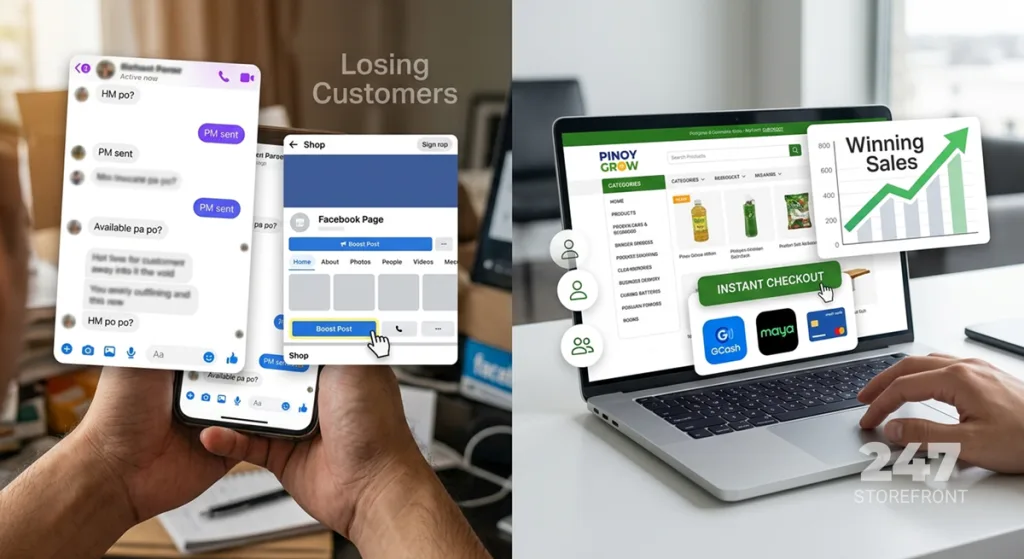
We all know the classic Philippine online shopping routine: a customer sees a post, comments “HM po?”, and the seller replies “PM sent.”
While this manual chat-based model worked well in 2020, consumer behavior in the Philippines has evolved rapidly. Today’s buyers value speed and convenience. Forcing potential buyers to jump into a private message just to find out a price creates unnecessary friction in your sales funnel.
Consider the difference between these two user experiences:
| Facebook Page Buying Process | Official Website Buying Process |
|---|---|
| 1. Customer sees your post at 11:00 PM. | 1. Customer visits your website at 11:00 PM. |
| 2. Customer comments or sends a message asking for price and availability. | 2. Customer views transparent pricing, size charts, and real-time inventory. |
| 3. Customer waits until morning for your admin to wake up and reply. | 3. Customer clicks “Buy Now” and pays via GCash, Maya, or Credit Card. |
| 4. Customer loses interest or buys from a competitor who replied faster. | 4. Order is automatically recorded, and confirmation is sent instantly. |
When you automate order processing and inventory through a website, you capture sales while you sleep instead of losing impatient buyers to faster competitors.
3. Search Intent: Filipinos Google Before They Buy
Social media is driven by discovery—people scroll through Facebook or TikTok to be entertained, not necessarily to shop. Google, on the other hand, is driven by intent. When someone opens Google and types a specific query, they are actively looking for a solution and are ready to buy.
If someone searches for a specialized service or product in your area (for example, “best commercial plumber in Quezon City” or “custom wooden furniture manufacturer Philippines”), Facebook pages rarely rank on the first page of Google search results.
Without an optimized website targeting relevant search terms, you are completely invisible to high-intent customers who are actively searching with their wallets out. Establishing a strong digital presence philippines strategy means capturing both social media browsers and active Google searchers.
4. The Credibility Gap: Building Online Trust with Filipino Consumers
Online scams are unfortunately common in the local market. Fake Facebook pages impersonating legitimate brands pop up daily, making consumers increasingly cautious about sending money to random bank accounts or GCash numbers provided in a chat window.
Having a professional, custom-designed website acts as an immediate badge of legitimacy. It shows that your business has invested real capital into its infrastructure, signaling permanence and stability. Key elements that build trust on a website include:
- An official custom domain name (e.g., yourcompany.com or .ph).
- Clear, published Terms of Service, Return Policies, and Privacy Policies.
- Secure HTTPS connections (the padlock icon in the browser bar).
- Integrated, verified payment gateways like PayMongo or Maya Business.
When comparing a brand with only a Facebook page against a brand with an official, polished website, modern Filipino shoppers consistently view the business with the website as more established and trustworthy.
5. Retargeting and Customer Data Ownership
When someone visits your Facebook page, Facebook learns everything about that user’s behavior. When someone visits your website, you get the data.
With basic tracking tools (like the Meta Pixel or Google Analytics) installed on your website, you can track exact user interactions. You can see which specific product pages a customer viewed, where they dropped off in the checkout process, and how long they stayed on your site.
This data allows you to run highly targeted, cost-effective re-marketing campaigns. Instead of spending money boosting generic posts to broad audiences, you can show targeted ads specifically to people who added items to their website cart but didn’t finish checking out.
How a Website and Facebook Page Work Best Together
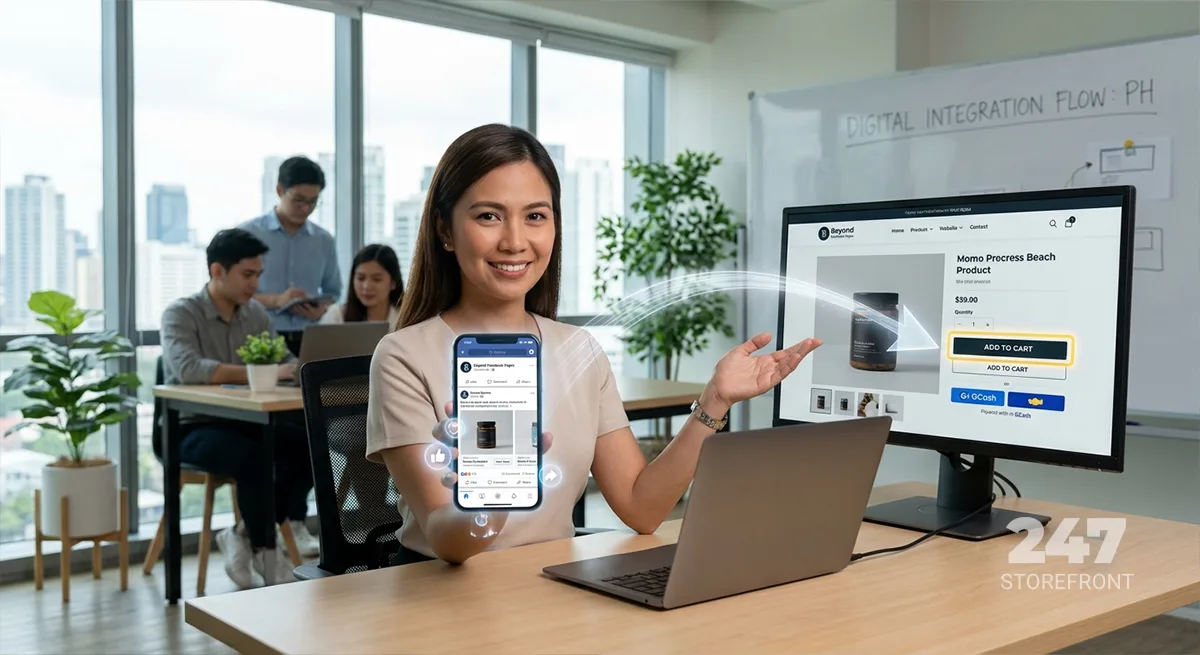
Moving beyond social media does not mean abandoning your Facebook or Instagram page. Social media remains one of the best tools for brand awareness, community building, and customer engagement in the Philippines.
The key is shifting your perspective: Social media should be the top of your marketing funnel, and your website should be the destination.
Use your social channels to create engaging videos, share updates, and start conversations. Then, direct that warm traffic to your website to browse your full catalog, read detailed service descriptions, or complete a secure purchase without administrative friction.
Final Thoughts
Relying solely on Facebook might have been enough to launch your business, but scaling requires a more resilient foundation. By building an official website, you protect your business against algorithm changes, eliminate sales friction, tap into high-intent search traffic, and build lasting brand authority in the local market.
Frequently Asked Questions
Is a website better than a Facebook Page for a small business in the Philippines?
Neither is inherently “better”—they serve different purposes. A Facebook Page is great for social engagement and discovery, while a website provides long-term stability, automated sales processing, search engine visibility, and brand credibility. The most effective approach is using both together.
Can I accept GCash and Maya on my website?
Yes. By integrating local payment gateways such as PayMongo, Xendit, or Maya Checkout, your website can automatically accept GCash, Maya, credit/debit cards, and online bank transfers with real-time payment confirmation.
How do I redirect my Facebook followers to my website?
Add your website URL to the “About” section of your Facebook page, include call-to-action buttons (like “Shop Now” or “Learn More”) on your posts, and feature your site link prominently in your pinned posts and bio.
Will having a website help my business rank on Google?
Yes. Websites can be optimized for search engine optimization (SEO), allowing your business to show up when potential customers search for relevant products or services on Google in the Philippines.
Is it difficult to manage a website if I am not technical?
Not anymore. Modern content management systems like WordPress allow you to easily update text, add new products, and view orders through user-friendly dashboards without needing to write code.